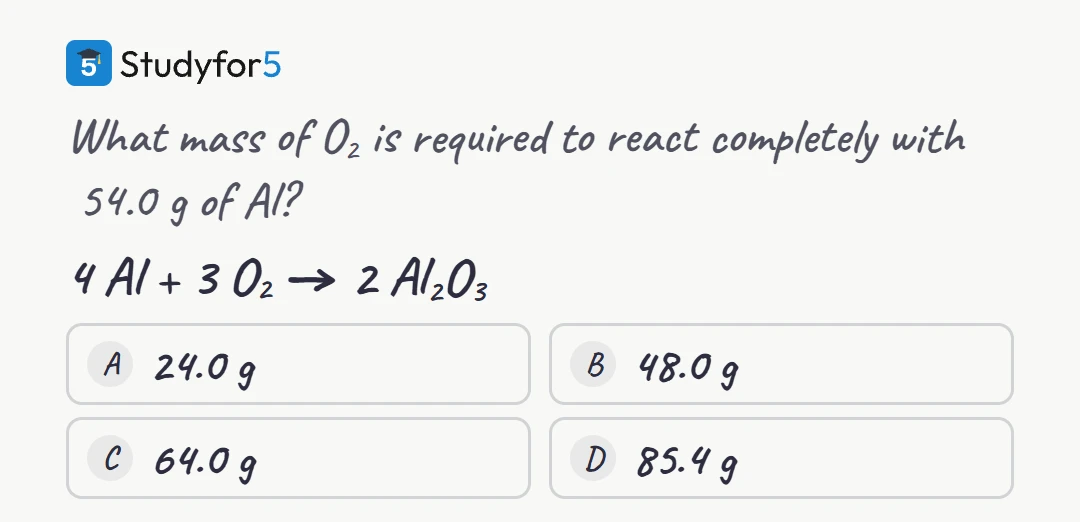
What mass of is required to react completely with 54.0 g of ?
- A) 24.0 g
- B) 48.0 g
- C) 64.0 g
- D) 85.4 g
Solving this Problem
When converting from grams of one substance to grams of another, it is important to remember that we must first convert to moles as an intermediate step. The coefficients in the balanced equation tell us how many moles of each substance react together in a given reaction, but we have no conversion factor that allows us to go directly from grams of one substance to grams of another. Since we know how many grams of we have, we should first convert it to moles so we use the coefficients in the equation to get from moles of to moles of . Only once we have moles of can we find the mass of needed.
Step 1
We have 54.0g of and we want to find out how many moles of that is. First we should find the molar mass of using the periodic table: 26.98 g/mol. This number means that every 1 mol of weighs 26.98 g. This fraction can be used either way depending on whether you are solving for final units of grams or moles. Since we want to end with moles, I will flip the fraction and divide so the grams of on the top and bottom cancel and we are left with moles of for our units.
Step 2
Now is the most important part. We must go from 2.00 mol of to moles of . To do this we look at the coefficients on the balanced equation. For every 4 moles of , 3 moles of are required to produce 2 moles of . Therefore, we can use the ratio 4 mol of to every 3 mol of to convert:
Again, this ratio can be flipped either way depending on if you are going from moles of to moles of aluminum, or moles of aluminum to moles of . In this case, we want moles of on the bottom so they cancel out and we are left with moles of .
Step 3
We are almost done. Now the last step is converting from moles of to grams of . Just like with , start by finding 's molar mass using the periodic table. is 16.0, but remember has 2 oxygens so we should double that. This means that there is 2 x 16 g of for every 1 mol of . Using this ratio we convert to grams:
The moles of cancel on the top and bottom, and just like that, we have our final answer and correct units! The answer is B, 48.0 g! Congratulations if you got this correct! The most important thing to remember is that our units from each step cancel with the next until you are left with the target unit (you can see this better with all the steps combined as shown below). If you are looking for more practice like this click the link below!
Watch the full solution
Studyfor5 has full AP Chemistry practice exams, FRQs graded in seconds with a rubric breakdown, and a predicted AP score so you always know where you stand.