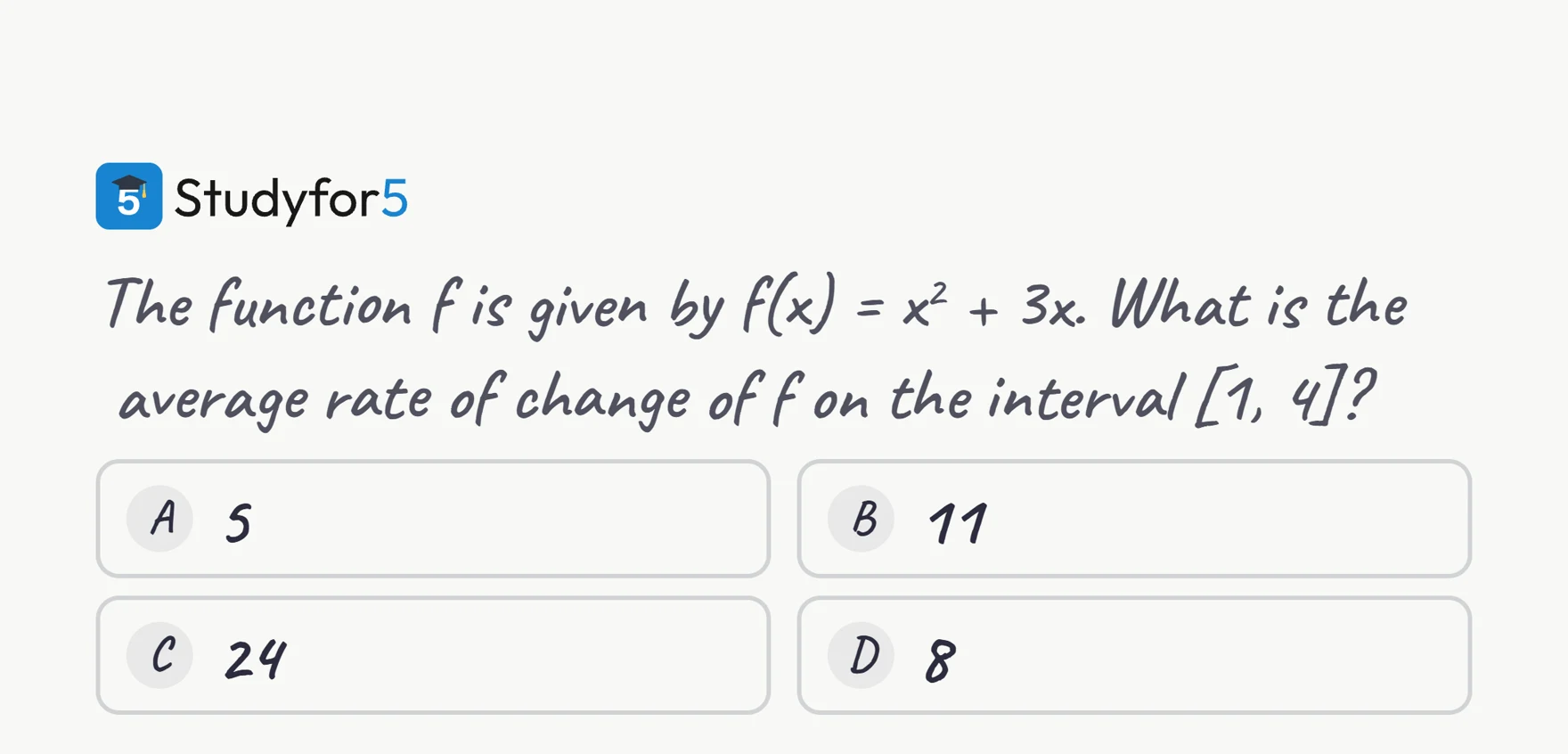
The function is given by . What is the average rate of change of on the interval from to ?
- A) 5
- B) 11
- C) 24
- D) 8
Solving this Problem
Average rate of change is just the slope between two points (so the change in or , divided by the change in ). Once you recognize this, these problems become easy. There is no calculating derivatives or finding instantaneous rates of change required for this problem.
In calculus, you will need to be able to find average rate of change over intervals, use variations of the average rate of change formula to define the derivative, and use the average rate of change to estimate derivative values. Make sure you understand this now.
Step 1: Find the function's value at each endpoint
The interval goes from to , so find the value at each endpoint to use in the numerator of the slope formula:
Step 2: Plug in to the slope formula and solve
So the average rate of change over the interval is 8. This means the correct answer is choice D, 8.
Having an average rate of change of 8 means that on average, for each increase of by one, the increases by 8 over the interval . This does not mean that it will increase by exactly 8 every time; it just means it will increase by 8 when all increases are averaged out. For more practice on this check the check your understanding quiz on lesson 2.1 Defining Average and Instantaneous Rates of Change at a Point.
Watch the full solution
Studyfor5's AP Calculus AB course is in early access while the rest of it is being built, and buying now locks in your price as more lessons, practice exams and graded free response questions are added.