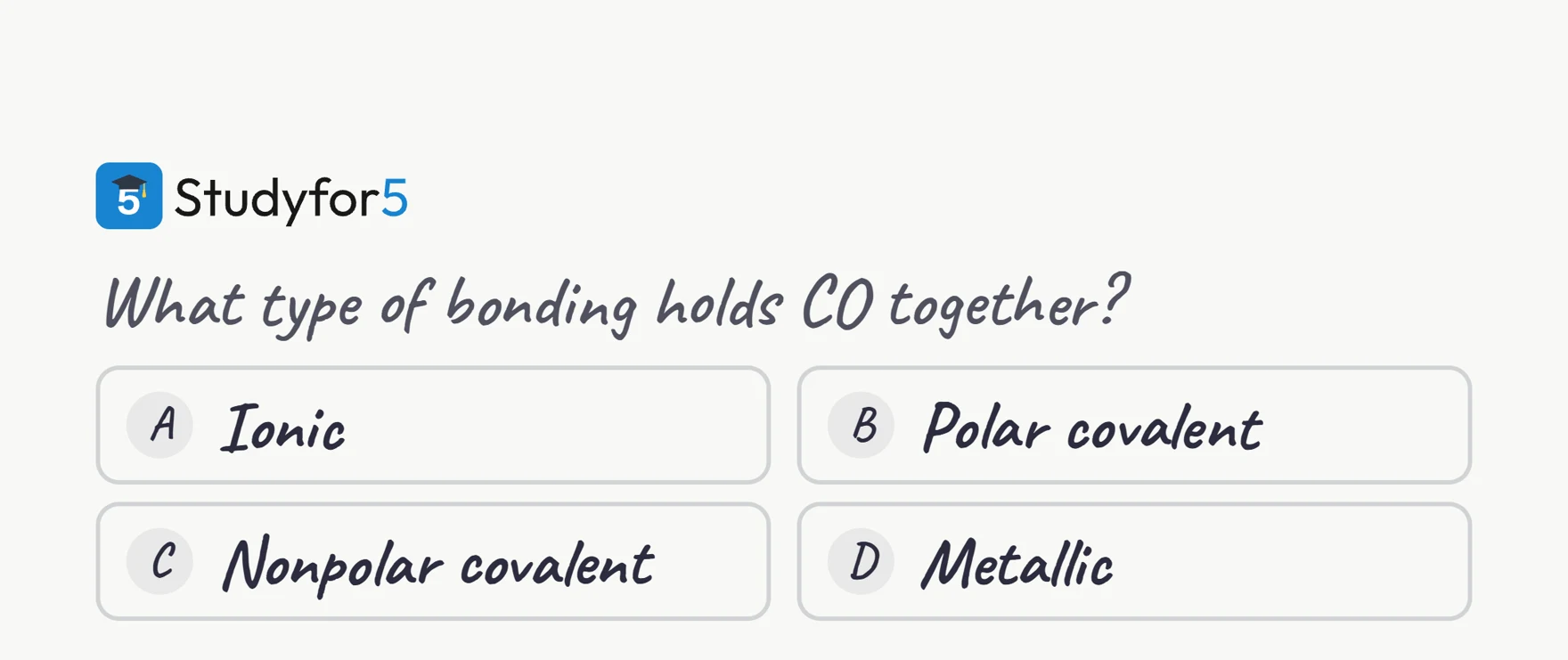
What type of bonding holds together?
- A) Ionic
- B) Polar covalent
- C) Nonpolar covalent
- D) Metallic
Identifying Bond Types
In AP Chem, the best way to identify the type of bonding is almost always looking at what types of atoms are being bonded. When a metal is bonded to a metal, the bonding type is metallic. When a metal is bonded to a nonmetal, the bonding type is ionic. And when a nonmetal is bonded to a nonmetal, you have covalent bonding. Also remember there are two types of covalent bonds: nonpolar covalent (when both atoms are the same) and polar covalent (when the atoms are not the same). These are the rules you must remember to be able to identify the bonding type. If you are looking for more information about the bonding types or why/how they work, check lesson 2.1 Types of Chemical Bonds.
Solving this Problem
To solve this problem, we need to first identify the types of the atoms that are being bonded, and then we can apply the rules as shown above to determine the bonding type.
Find and on the periodic table. Both elements are in the upper right corner, and based on their location on the periodic table, we know they are both nonmetals. And because they are two different nonmetals, this will be polar covalent bonding. So the correct answer is B, polar covalent bonding.
Note that for this to have been nonpolar covalent bonding, it would have had to be a molecule such as or , which have two of the same element bonded together. For the purposes of AP Chemistry, these are the only nonpolar covalent bonds you will have to deal with.
Watch the full solution
Studyfor5 has full AP Chemistry practice exams, FRQs graded in seconds with a rubric breakdown, and a predicted AP score so you always know where you stand.